Esta é uma aula de conversação de verdade: você lê sobre um assunto que vale a pena saber, o sono, e usa o inglês para discutir o que leu. O texto principal vem em 3 níveis, com áudio e tradução ao toque. Antes, um aquecimento de mito ou fato. Depois, as regras para dormir melhor, o que a falta de sono faz com o corpo e um debate sobre trocar sono por produtividade, todos em 3 níveis. No fim, duas atividades e as perguntas de discussão para levar para a aula.
Como usar esta página
Faça o aquecimento, escolha o nível (1, 2 ou 3), dê play e leia junto. Toque em qualquer palavra para ver a tradução. Depois faça as duas atividades e responda a duas perguntas de discussão em voz alta, em inglês, por um minuto cada. Em aula, o professor usa as mesmas perguntas.
Warm-up: myth or fact?
Antes de ler, teste o que você já acha que sabe. São seis frases que todo mundo já ouviu sobre sono; para cada uma, escolha myth (mito) ou fact (fato). As respostas estão nos textos desta página.
Quiz
Myth or fact?
Seis frases sobre sono. Escolha myth ou fact e veja o porquê.
“A glass of wine helps you sleep better.” This is a .
Toque na opção que completa a frase.
Reading: the science of sleep
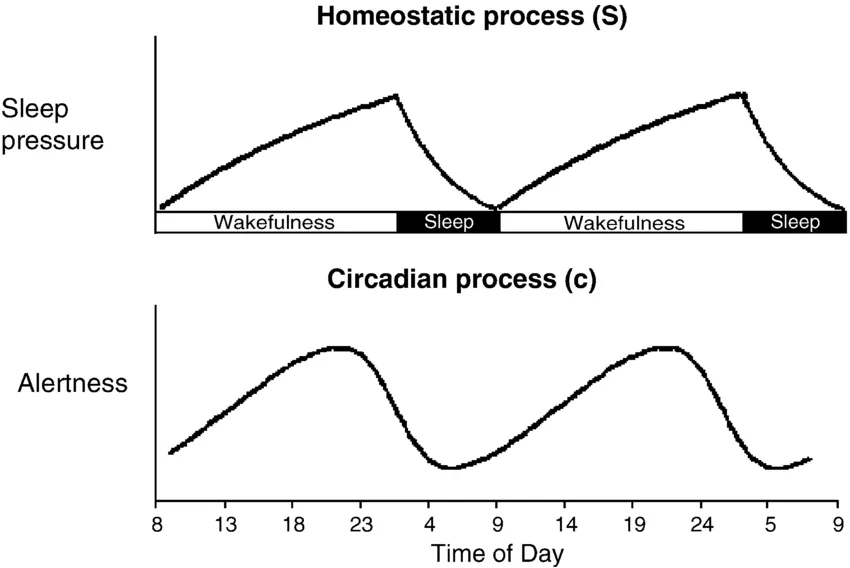
O texto segue o livro Why We Sleep, de Matthew Walker: os estágios do sono, por que o ser humano dorme menos que o chimpanzé, por que existem pessoas da manhã e da noite, e os dois relógios que regulam o sono. Os três níveis contam a mesma história; muda o tamanho das frases e o vocabulário.
💡 Toque em qualquer palavra para ver a tradução e ouvir a pronúncia. Dê play para ouvir o texto inteiro com a voz do navegador. Nível 1 é A2, Nível 2 é B1, Nível 3 é B2.
0:00
. , . : . . , .
. 9 10 . 7 8 . , . . : , . .
. "": . "": . . , . "". , , .
. . . 24-. . . , .
, 30 60 , . . .
, , . , .
How to sleep better: simple rules that work
As regras vêm da higiene do sono clássica e aparecem no livro de Walker. Escolha o nível, leia uma vez ouvindo e, depois, tente dizer de cabeça quais você já segue e quais não. O Nível 3 explica o porquê de cada regra.
💡 Toque em qualquer palavra para ver a tradução, ou dê play para ouvir. As mesmas regras nos três níveis.
0:00
: , , , .
. , . , . .
, . 2 . . .
, , . , 19 °. .
, . . , .
The benefits of sleep, and the damage of sleeping too little
Este é o texto mais difícil da página: um resumo com as citações das pesquisas que Walker reúne no livro, do B1 ao C1 (o Nível 3 é o original, em linguagem de artigo científico). Cada parêntese, como (Yoo, 2007), corresponde a um estudo da lista de referências no fim. Para quem trabalha com saúde, é vocabulário de artigo científico.
💡 Toque em qualquer palavra para ver a tradução, ou dê play para ouvir. No Nível 3, repare nos conectores: while, whereas, consistent with, converge on.
0:00
. , , , , . .
() . (, 2017). , , (, 2007). (, 2015). (, 2006).
. , , , (, 2004). (, 1999). , , (, 2010).
: .
The two-hour trade: is sleeping less a productivity hack?
Dormir seis horas em vez de oito dá duas horas a mais por dia. É a conta que muito executivo faz, e ela parece fechar. Este texto mostra o que a pesquisa diz sobre ela, inclusive as críticas ao próprio Walker. Ele não dá veredito: o veredito é seu, no debate logo abaixo.
💡 Toque em qualquer palavra para ver a tradução, ou dê play para ouvir. Os três níveis trazem os mesmos estudos; o Nível 3 é o mais próximo de uma reportagem de negócios.
0:00
, . : . . .
. , (, 2003). , . : . .
. , (, 2000). . , (, 2016).
. (, 2009). , . "" .
, ? , . .
Debate: two sides of the trade
Escolha um lado, mesmo que não concorde com ele, e defenda por um minuto. Depois troque de lado. Use os argumentos da tabela e as frases de opinião da seção de conversa, mais abaixo.
Sleep less: the case
Sleep enough: the case
Two hours a day is fourteen hours a week.
Each extra hour is a worse hour.
I feel fine on six hours.
People on six hours feel fine too, and they are not fine.
Some people need only six hours.
Only a tiny minority has the short-sleep gene.
Walker's book exaggerates some numbers.
The main point does not depend on the dramatic numbers.
Busy jobs don't leave time for eight hours.
Tired workers cost companies millions of working days.
Debate questions
Toque em Responder e fale em inglês por um minuto. Defenda um lado com um argumento da tabela e um exemplo seu.
Respondidas: 0 de 2
Question 1 of 4
? .
1 / 4
Video: the science of sleeping
O vídeo repassa o conteúdo da leitura: estágios, ritmo circadiano e os efeitos da falta de sono. Assista uma vez sem legenda e anote três palavras que você reconheceu do texto.
Atividades
1 · Ligue a expressão ao sentido
As expressões vêm dos textos desta página, quase todas do resumo científico e do debate. Ligue cada uma ao que ela quer dizer; o par certo acende e é falado.
Toque numa expressão em inglês e depois no sentido em português.
0 de 10 · 0 tentativas
2 · Quiz de compreensão
Oito perguntas sobre a leitura principal, as regras e a troca de duas horas. Funciona em qualquer nível.
Quiz
Quiz de compreensão: você entendeu o texto?
Oito perguntas sobre a página. Feedback na hora, em qualquer nível.
REM sleep is marked by .
Toque na opção que completa a frase.
Conversation: say what you think
Frases para opinar
Responder a uma pergunta de discussão é dar uma opinião, sustentar com um exemplo e reagir ao que o outro disse. Estas frases fazem esse trabalho; escolha uma de cada momento antes de responder.
A primeira frase da resposta. Ela diz de que lado você está antes de explicar.
.
Opinião firme, sem ser agressivo.
, , .
Para marcar que é a sua visão.
.
Quando você tem certeza.
, .
Quando você ainda está decidindo.
Logo depois da opinião. É o exemplo que faz a resposta durar um minuto.
, .
Exemplo da sua vida.
, .
Exemplo concreto do efeito.
, .
Para usar um dado do texto.
Quando o outro tem razão em parte. É a frase mais útil numa reunião.
, .
Concorda e abre a exceção.
. , .
Reconhece e contrapõe com dado.
, ?
Concorda e muda o horizonte.
Para discordar sem fechar a conversa.
.
Discordância educada e clara.
.
Curta, neutra, serve em qualquer situação.
. .
Discorda e já puxa o argumento.
1 de 4
Arraste, use as setas ou toque no momento · toque numa palavra para ver a tradução
Discussion questions
Escolha duas perguntas, toque em Responder e fale em inglês por um minuto. Não precisa de resposta certa: precisa de opinião e de um exemplo da sua vida. Toque nas palavras que não conhecer.
Yoo, S-S. et al. (2007). “A deficit in the ability to form new human memories without sleep.” Nature Neuroscience, 10(3): 385-392. doi.org/10.1038/nn1851
Prather, A.A. et al. (2015). “Behaviorally Assessed Sleep and Susceptibility to the Common Cold.” Sleep, 38(9): 1353-1359. doi.org/10.5665/sleep.4968
Irwin, M.R. et al. (2006). “Partial night sleep deprivation reduces natural killer and cellular immune responses.” PNAS, 103(5): 1918-1923. doi.org/10.1073/pnas.0510074103
Taheri, S. et al. (2004). “Short sleep duration is associated with reduced leptin, elevated ghrelin, and increased BMI.” PLoS Medicine, 1(3): e62. doi.org/10.1371/journal.pmed.0010062
Czeisler, C.A. et al. (1999). “Sleep deprivation and circadian misalignment: impacts on endocrine and cardiovascular systems.” JCEM, 84(2): 552-555. doi.org/10.1210/jcem.84.2.5443
Cappuccio, F.P. et al. (2010). “Sleep duration and all-cause mortality: a systematic review and meta-analysis.” Sleep, 33(5): 585-592. doi.org/10.1093/sleep/33.5.585
Van Dongen, H.P.A. et al. (2003). “The cumulative cost of additional wakefulness: dose-response effects on neurobehavioral functions and sleep physiology from chronic sleep restriction and total sleep deprivation.” Sleep, 26(2): 117-126. doi.org/10.1093/sleep/26.2.117
Williamson, A.M. & Feyer, A.M. (2000). “Moderate sleep deprivation produces impairments in cognitive and motor performance equivalent to legally prescribed levels of alcohol intoxication.” Occupational and Environmental Medicine, 57(10): 649-655. doi.org/10.1136/oem.57.10.649
Hafner, M. et al. (2016). Why Sleep Matters: The Economic Costs of Insufficient Sleep. RAND Corporation. rand.org
He, Y. et al. (2009). “The transcriptional repressor DEC2 regulates sleep length in mammals.” Science, 325(5942): 866-870. doi.org/10.1126/science.1174443
Guzey, A. (2019). “Matthew Walker's Why We Sleep is riddled with scientific and factual errors.” A crítica mais conhecida ao livro. guzey.com
Perguntas frequentes
Perguntas frequentes
Qual nível devo escolher?
Comece pelo Nível 2. Se precisar tocar em mais de uma palavra por frase, desça para o Nível 1; se leu sem parar, suba para o Nível 3. Os três contam a mesma história.
Como funciona o áudio?
O play usa a voz em inglês do seu próprio navegador ou celular. Não é gravação: por isso funciona em qualquer nível e você pode parar e recomeçar quantas vezes quiser.
Como usar esta aula com um professor?
Leia o texto antes da aula e responda ao quiz. Na aula, o tempo vai para as perguntas de discussão: o professor pergunta, você responde e ele corrige o que saiu errado. É assim que a conversação da Lingualize funciona.
Dormir menos aumenta a produtividade?
Dá mais horas, mas cada hora rende menos, e quem dorme pouco quase nunca percebe a perda. No estudo de Van Dongen, seis horas por noite durante duas semanas deixaram o desempenho no nível de quem passou até duas noites sem dormir. Existem pessoas que funcionam bem com seis horas, mas são raríssimas e têm uma mutação genética.
O texto segue o livro de Matthew Walker?
Segue. Why We Sleep (2017) é a base da leitura e do resumo científico; os estudos citados entre parênteses estão na lista de referências. O livro também recebeu críticas por exagerar alguns números, e a mais conhecida está na lista, para quem quiser ver os dois lados.
Discuta este texto em inglês com um professor
Ler e entender você já faz sozinho. Defender uma opinião sobre cochilo no trabalho, em inglês, com alguém corrigindo o que sai torto, é a parte que só acontece em aula. É exatamente isso que a aula teste faz, com este texto ou com outro que você escolher.
Pratique inglês com música e jogos no Fill The Song — outra ferramenta gratuita da nossa rede. E se o objetivo é evoluir para o trabalho, conheça o curso de inglês para executivos da Lingualize.