
Lay e lie são dois dos verbos que mais confundem — inclusive nativos. A boa notícia: com uma regra simples e um pouco de prática, você domina os dois de vez.
Este guia destrincha a diferença entre lay (colocar algo) e lie (deitar-se, estar), com as conjugações irregulares que pegam todo mundo. Para professores: material direto para uma aula sobre verbos confundíveis. (Conteúdo em inglês abaixo.)
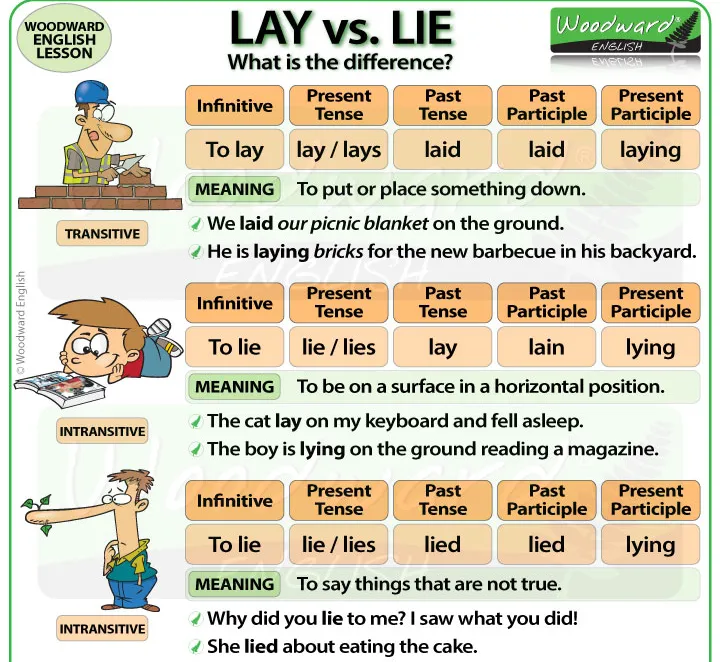
Lay = colocar algo (lay–laid–laid). Lie = deitar-se / estar (lie–lay–lain). O “lay” do passado de “lie” é a maior fonte de confusão.
Students will differentiate and correctly use the verbs "lay," "lie" (to recline), and "lie" (to tell a falsehood) in both present and past tenses. Start with a brief introduction to the importance of verb tense and the confusion that often arises with verbs that have similar forms but different meanings.
Verbs
Lay (to put or place something down):
- Present tense: lay (requires a direct object): colocar ou pôr algo em algum lugar. "Every day, I lay the book on the table."
- Past tense: laid "Yesterday, I laid the book on the table."
- Participle: laid "The book has been laid on the table."

Lie (to recline):
- Present tense: lie (does not require a direct object): deitar-se. "I often lie down on the sofa to read."
- Past tense: lay "Yesterday, I lay down on the sofa to read."
- Participle: lain. "I have lain on this sofa many times."

Lie (to tell a falsehood):
- Present tense: lie: mentir "He lies about his age."
- Past tense: lied "He lied about his age yesterday."
- Participle: lied "He has lied about his age before."

Guided Practice (10 minutes):
- Provide sentences where students have to choose the correct form of "lay," "lie" (to recline), or "lie" (to tell a falsehood) based on the context. Mix in present and past tense forms.
Independent Practice (15 minutes):
- Sentence Transformation Exercise:
- Students write sentences using both the present and past tense forms of "lay" and "lie" (both meanings). They should create a pair of sentences for each verb, one in the present tense and one in the past tense.
- Role-Playing:
- In pairs, students role-play short dialogues where they incorporate the correct use of "lay," "lie" (to recline), and "lie" (to tell a falsehood). One student lays out a scenario, and the other responds using one or more of the target verbs correctly.
Review and Reflection (5 minutes):
- Review key points and common mistakes.
- Have a few students share their sentences and dialogues with the class to correct and discuss as a group.
- Reflect on the importance of understanding verb tense and meaning in effective communication.
Homework:
- Students write a short story or a diary entry using "lay," "lie" (to recline), and "lie" (to tell a falsehood) correctly at least once. Encourage creative stories that clearly demonstrate the understanding of the verb tenses and meanings.
This lesson plan aims to clarify the usage of "lay" and "lie" in different contexts and tenses, enhancing students' grammar skills through practical and engaging activities.
Overview
Pratique inglês com música e jogos no Fill The Song — outra ferramenta gratuita da nossa rede. E se o objetivo é evoluir para o trabalho, conheça o curso de inglês para executivos da Lingualize.
Procurando aulas? Veja a aula particular de inglês, a aula de conversação e todas as aulas da Lingualize.